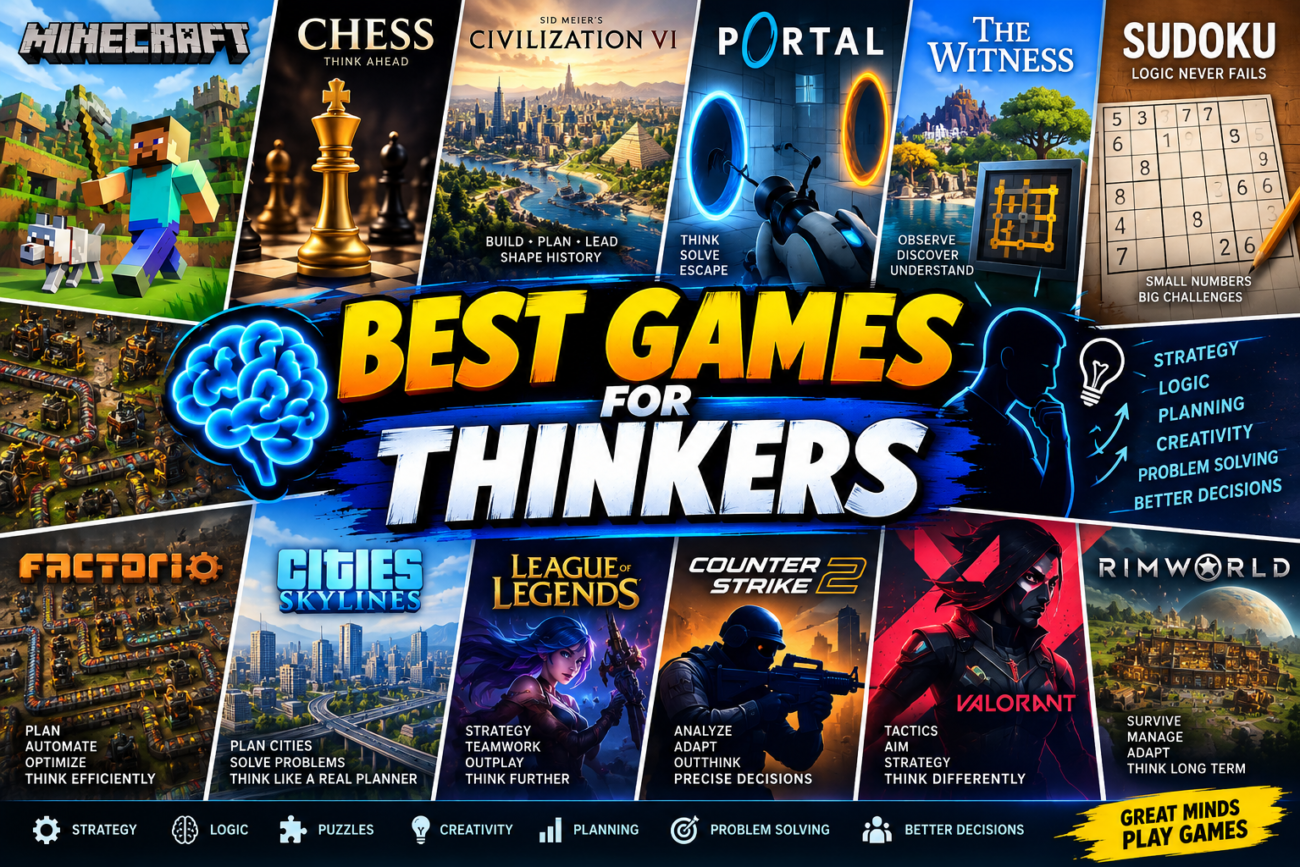
Video games are often described as a form of entertainment, but some games offer something much deeper. They challenge players to observe carefully, make difficult decisions, recognize patterns, solve problems, manage resources, and think several steps ahead. These are the games that appeal to people who enjoy using their minds as much as their reflexes.
For a thoughtful player, winning is not always about moving faster or having better reactions. Sometimes the most important advantage is being able to understand a situation, identify the possibilities, predict what could happen next, and choose the right solution.
Games designed around strategy, logic, puzzles, planning, and creativity have become an important part of the gaming world. They can be relaxing, competitive, educational, challenging, or all of these things at the same time.
What Makes a Game Perfect for a Thinker?
A game for thinkers does not necessarily have to be difficult. What matters is the type of decisions it asks the player to make.
Some games require logical reasoning. Others demand long-term planning. Strategy games may force players to manage limited resources, while puzzle games require them to recognize patterns and understand systems.
A great thinking game often gives the player a problem without immediately providing the answer.
The player must experiment.
They must make mistakes.
They must learn from those mistakes.
Then they must try again with a better strategy.
This process can make these games extremely satisfying because success feels earned through understanding rather than luck alone.
Chess: The Classic Strategy Game
Chess is perhaps the most famous example of a game built around thinking.
The rules are relatively simple, but the number of possible decisions becomes enormous as a match develops. Every move can change the position of the entire board.
Players need to think about the immediate consequences of their decisions while also considering what their opponent might do several moves later.
A strong chess player does not simply ask, “What move can I make?”
They ask:
“What is my opponent trying to accomplish?”
“What happens if I make this move?”
“Which pieces are vulnerable?”
“Can I create a better position several turns from now?”
This combination of planning, prediction, pattern recognition, and adaptation makes chess one of the ultimate games for analytical thinkers.
Civilization: Building an Empire Through Decisions
The Civilization series takes strategic thinking to an entirely different scale.
Instead of controlling a small group of units during a short match, players are responsible for developing an entire civilization.
They must decide where to build cities, how to use resources, which technologies to research, how to interact with neighboring civilizations, and how to respond when unexpected events occur.
A decision that seems insignificant at the beginning of a game can have consequences many turns later.
This makes Civilization especially interesting for players who enjoy long-term planning.
There is rarely a single correct strategy. A player can focus on science, military strength, culture, diplomacy, economics, or a combination of several approaches.
The challenge comes from understanding how all these systems interact.
Minecraft: Creativity as a Form of Intelligence
Minecraft is often associated with creativity and exploration, but it can also be an excellent game for thinkers.
Building a complex structure requires planning, spatial awareness, resource management, and problem-solving.
Players may begin with a simple idea and gradually transform it into an enormous project.
Survival mode introduces another layer of strategic thinking. Resources are limited, hostile creatures appear at night, and players need to decide how to use the materials available to them.
Redstone mechanics take this even further.
Players can create automated farms, machines, doors, transportation systems, calculators, traps, and other mechanisms by combining different components.
Minecraft demonstrates that thinking does not always mean solving traditional puzzles. Sometimes intelligence is expressed through the ability to design, experiment, and create something that did not previously exist.
Portal: Learning to Think Differently
Portal is one of the best examples of a game that teaches players to change their way of thinking.
The central mechanic involves creating portals that connect different locations. At first, the concept seems simple. However, the puzzles gradually introduce increasingly complex situations.
Players must understand momentum, spatial relationships, timing, physics, and environmental clues.
The most interesting part is that the solution is often not directly in front of the player.
You may look at a room and think there is no possible way to reach the destination.
Then you realize that the walls, floor, momentum, and portals can be combined in a completely different way.
That moment of discovery is one of the greatest pleasures in puzzle gaming.
The Witness: Observation and Patience
The Witness takes a more mysterious approach to intellectual gameplay.
The player explores an island filled with puzzles, but the game rarely explains everything directly.
Instead, players must observe the environment and discover the rules themselves.
A puzzle may appear confusing at first. After solving several related puzzles, however, the player begins to recognize a hidden pattern.
This makes observation one of the most important skills in the game.
The Witness rewards players who are willing to slow down, examine their surroundings, question their assumptions, and learn from previous discoveries.
It is an excellent example of a game where the player’s understanding becomes more powerful than any traditional character upgrade.
Sudoku and Logic Puzzle Games
Sometimes the best game for a thinker is also one of the simplest.
Sudoku requires players to place numbers according to a set of logical rules. There is no need for complicated graphics, fast reactions, or expensive hardware.
The challenge comes entirely from reasoning.
Similar puzzle games use numbers, words, shapes, colors, or patterns to create problems that must be solved through logic.
These games are particularly appealing to people who enjoy finding order in seemingly complicated situations.
A good puzzle creates a feeling of uncertainty at first and clarity at the end.
Factorio: Building a Machine That Thinks
Factorio is an extraordinary game for players who enjoy systems and optimization.
The basic concept involves creating and expanding an automated factory.
At first, the player may manually collect resources and produce basic items. Eventually, increasingly complex production chains become necessary.
Iron must be processed.
Machines need energy.
Resources need transportation.
Production needs to be optimized.
Bottlenecks must be identified.
The player gradually creates a system where machines work together automatically.
The challenge is not simply building more. It is building efficiently.
This makes Factorio particularly attractive to analytical thinkers who enjoy optimization and engineering-style problems.
Cities: Skylines: Thinking Like a Planner
Cities: Skylines transforms the player into a city planner.
Building a city may appear straightforward, but successful development requires understanding how different systems interact.
Roads influence traffic.
Traffic affects transportation.
Transportation influences where people live and work.
Industrial areas can create pollution.
Residential areas require services.
Businesses need customers and workers.
A poorly planned road can eventually create traffic problems across an entire city.
This makes the game an interesting exercise in systems thinking.
The player learns that solving one problem can sometimes create another problem somewhere else.
Civilization and the Art of Long-Term Thinking
One of the most valuable skills in strategic games is understanding the difference between a short-term advantage and a long-term advantage.
A player might have the opportunity to gain something immediately, but taking it could weaken their position later.
Strategic games constantly create these decisions.
Should you attack now or prepare first?
Should you spend resources on defense or development?
Should you expand quickly or strengthen what you already control?
Should you cooperate with another player or prepare for conflict?
There is rarely a perfect answer.
The best decision depends on the situation.
This is what makes strategy games so engaging for people who enjoy analyzing possibilities rather than simply following predetermined paths.
Strategy Games Teach Adaptation
Thinking is not only about planning.
It is also about adapting when the plan fails.
A player can enter a match with an excellent strategy and still lose because circumstances change.
An opponent may make an unexpected move.
A resource may become unavailable.
A new threat may appear.
A carefully designed plan may suddenly become useless.
The ability to change direction is therefore one of the most important skills in strategic gaming.
The smartest player is not necessarily the person who has the most complicated plan.
It is often the person who recognizes when their plan is no longer working.
Puzzle Games and the Psychology of Failure
Failure has a special role in puzzle games.
In many games, losing can feel frustrating because the player believes they made a mistake.
In a well-designed puzzle game, however, failure can provide information.
You tried something.
It did not work.
Now you know something that you did not know before.
This turns failure into part of the learning process.
The player gradually eliminates incorrect possibilities until the correct solution becomes clear.
That process can be extremely rewarding because the final solution often seems obvious once the player understands the underlying rule.
Games That Reward Curiosity
Some of the best games for thinkers do not tell players exactly what they should do.
Instead, they encourage curiosity.
Why is this object here?
What happens if I interact with it?
Why does this system behave differently?
Is there another way to solve this problem?
Could I approach this situation from another direction?
Curiosity encourages experimentation, and experimentation often leads to unexpected discoveries.
Games that reward curiosity can therefore feel more like interactive laboratories than traditional entertainment.
Competitive Games Also Require Intelligence
Thinking games are not limited to puzzles and strategy titles.
Competitive games such as League of Legends, Counter-Strike 2, Valorant, StarCraft II, and many others require considerable mental skill.
Players must constantly process information.
Where is the opponent?
What resources are available?
What is the enemy likely to do?
Should we attack?
Should we defend?
How much time remains?
What information does the opposing team have?
High-level competitive gaming involves decision-making under pressure.
A professional player is not simply reacting to what happens on screen. They are constantly predicting what could happen next.
The Importance of Pattern Recognition
Pattern recognition is another major element of intelligent gameplay.
Experienced players begin to recognize situations that newer players may not notice.
A certain movement might indicate an opponent’s strategy.
A particular resource arrangement might suggest an optimal solution.
A specific enemy behavior might reveal what will happen next.
Over time, players build a mental library of patterns.
This is one reason experienced players can sometimes appear to make decisions instantly.
They are not necessarily thinking less.
They have learned to recognize situations faster.
Creativity and Problem Solving
Not all intelligent gameplay is based on strict logic.
Creativity can be just as important.
Games such as Minecraft, Roblox, LittleBigPlanet, Dreams, and many sandbox titles allow players to solve problems in unconventional ways.
Instead of asking, “What is the correct solution?”
The player can ask:
“What solution can I create?”
This difference is important.
Creative games allow players to experiment with possibilities that the developers may not have explicitly designed as the primary solution.
That freedom can produce extraordinary results.
Why Thinkers Love Games With Complex Systems
Complex systems create a special type of satisfaction.
When multiple mechanics interact, players can discover relationships that are not immediately obvious.
Changing one variable can influence several others.
This creates a kind of mental puzzle that can continue for hundreds of hours.
Games such as Factorio, Civilization, Cities: Skylines, RimWorld, Oxygen Not Included, and many simulation titles are built around these interactions.
Players are not simply completing levels.
They are learning how a system behaves.
The Difference Between Difficulty and Depth
A difficult game is not necessarily a deep game.
Difficulty can come from fast enemies, complicated controls, limited time, or demanding reflexes.
Depth is different.
A deep game gives players meaningful choices.
It allows different strategies to produce different outcomes.
It rewards experimentation and understanding.
Some games are difficult because they require excellent reflexes.
Others are difficult because they require players to understand complicated systems.
The best games for thinkers often combine both.
Games Can Train the Habit of Asking Questions
One of the most valuable aspects of intelligent games is the habit of questioning.
Instead of accepting the first solution, players learn to consider alternatives.
Could there be another route?
Is there a better strategy?
What information am I missing?
Why did this attempt fail?
What would happen if I changed one part of the plan?
This type of thinking can make games more engaging while encouraging players to approach challenges from multiple perspectives.
The Best Games for Thinkers Are Not Always the Most Complicated
A game does not need hundreds of systems to challenge the mind.
A simple puzzle can be incredibly difficult.
A small board can contain thousands of strategic possibilities.
A short level can require careful observation.
Sometimes the most effective intellectual games are those that present a simple set of rules and then create surprisingly complex situations from them.
That is one of the reasons chess has remained relevant for centuries.
The rules are straightforward.
The possibilities are enormous.
Final Thoughts
Games for thinkers offer something different from traditional entertainment.
They ask players to slow down, observe, experiment, plan, adapt, and understand.
Whether the challenge involves solving a puzzle in Portal, designing a massive machine in Factorio, planning a civilization in Civilization, creating an incredible world in Minecraft, managing a city, studying an opponent in chess, or making a split-second strategic decision in a competitive game, the underlying appeal is similar.
The player is not simply being entertained.
The player is being challenged to figure something out.
That is what makes intelligent games so memorable.
The greatest reward is not always a trophy, a high score, or a victory screen.
Sometimes the best reward is that moment when everything suddenly makes sense.
You see the pattern.
You understand the system.
You discover the solution.
And you realize that the answer was there all along—you simply had to think differently to find it.
